
Moving in Dubai Marina requires specialist movers because of high-rise buildings, restricted loading zones, tight elevators, management permits, and heavy pedestrian traffic. A successful Marina move depends on pre-approved permits, elevator sequencing, parking coordination, protective packing, insurance, and a clear chain of responsibility. Read this guide to cover every operational, legal, timing, equipment, cost, and customer-preparation detail you need.
This article covers everything a resident, building manager, facilities coordinator, or office manager must know about hiring local movers in Dubai Marina. It explains high-rise logistics, building rules, parking, elevator sequencing, packing standards, crew roles, equipment, storage options, cost drivers, sample timelines, templates (inventory, NOC/elevator booking), insurance, risk mitigation, day-of checklists, and FAQs.
Why are Dubai Marina moves unique?
Dubai Marina combines dense high-rise residential towers, waterfront commercial units, and tight access zones, creating logistical constraints not found in low-rise suburbs. Movers must align with tower policies, navigate restricted loading bays, and manage long carry distances from truck to apartment. Standard movers without Marina experience usually cause delays, fines, or damage.
High-rise moving challenges, The issues you must plan for
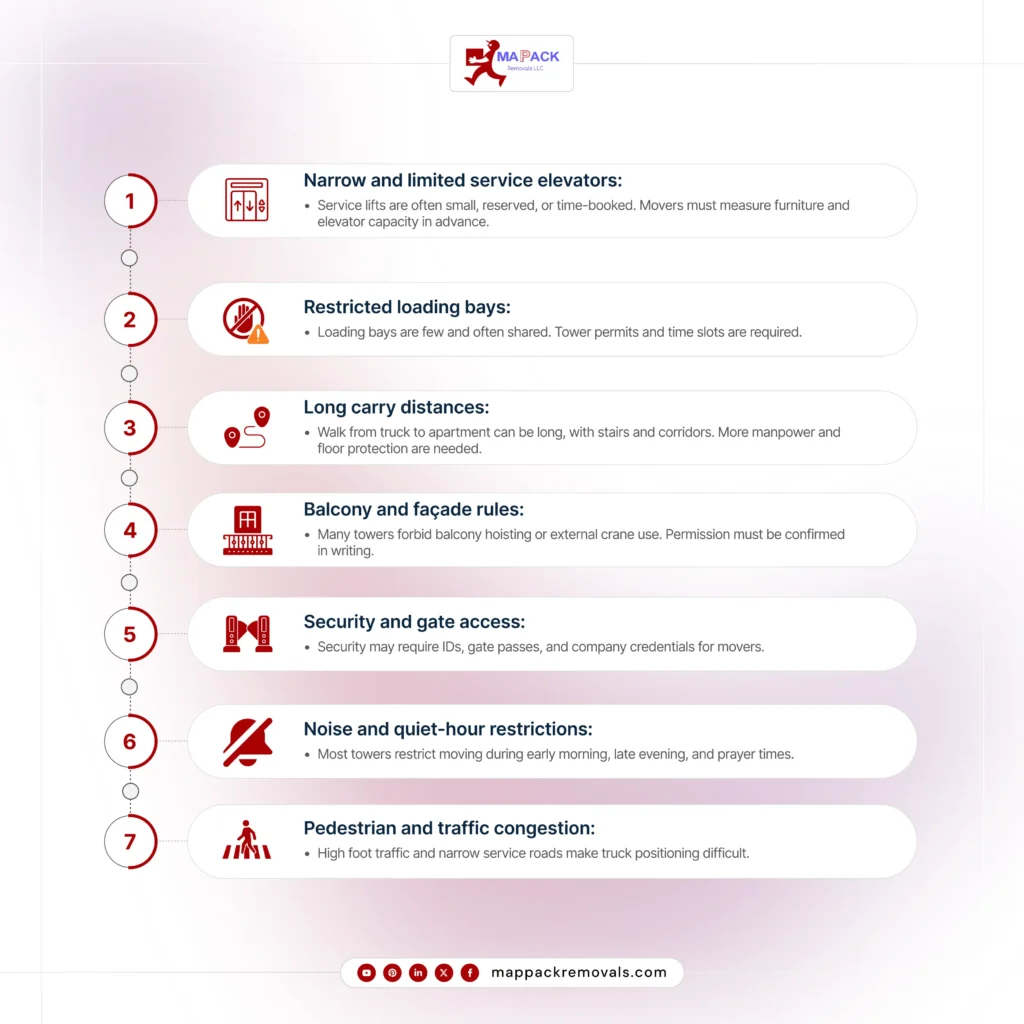
1. Narrow and limited service elevators.
Service lifts are often small, reserved, or time-booked. Movers must measure furniture and elevator capacity in advance.
2. Restricted loading bays.
Loading bays are few and often shared. Tower permits and time slots are required.
3. Long carry distances.
Walk from truck to apartment can be long, with stairs and corridors. More manpower and floor protection are needed.
4. Balcony and façade rules.
Many towers forbid balcony hoisting or external crane use. Permission must be confirmed in writing.
5. Security and gate access.
Security may require IDs, gate passes, and company credentials for movers.
6. Noise and quiet-hour restrictions.
Most towers restrict moving during early morning, late evening, and prayer times.
7. Pedestrian and traffic congestion.
High foot traffic and narrow service roads make truck positioning difficult.
Building management restrictions, what buildings typically require
Common requirements:
- Move-in/out permit or NOC.
- Security approval and ID submission for each mover.
- Elevator booking with designated time slots.
- Deposit or insurance bond for potential damages.
- Approved moving hours and no-go times.
- Proof of mover’s trade license and insurance.
- Trash removal rules and post-move cleanup requirements.
Action: always get building management approvals in writing (email/PDF).
Pre-move stage, planning, surveys and permits
1. Site survey (mandatory).
A site survey records floor plans, elevator dimensions, loading bay location, parking, stair width, balcony rules, and building contact. Movers should perform this with photos and dimensions.
2. Inventory & valuation.
Create a detailed inventory with item descriptions, photos, approximate values, and packing requirements. Use unique IDs for cartons.
3. Elevator and loading bay booking.
Book elevator slots in writing. Request loading bay and truck parking permissions. Confirm security point of contact and phone.
4. Permit / NOC submission.
Submit the mover’s license, insurance certificate, vehicle details, and ID list as required.
5. Method statement for large or special items.
For pianos, safes, large chandeliers, or artworks provide risk assessment and method statements to building management.
6. Insurance confirmation.
Confirm mover’s insurance (basic vs. full-value) and obtain a copy.
Crew roles and responsibilities, the exact team composition
Typical crew for Marina moves:
- Move supervisor (1): primary contact, manages permits and building interface.
- Lead mover / foreman (1): directs loading/unloading.
- Pack team (2–4): pack and prepare items the day before or morning-of.
- Loaders (2–6): move items, operate trolleys, secure load.
- Driver(s) (1–2): vehicle operation, GPS monitoring.
- Assembly team (1–3): reassembles furniture, sets up appliances.
- Clean-up person (optional): removes waste and returns the site tidy.
Tip: use trained crews that practice two-person lifts and high-rise etiquette.
Equipment & protective materials
Essential equipment:
- Heavy-duty moving blankets and padded wraps.
- Corner protectors for doors and furniture.
- Strong double-walled cartons and wardrobe boxes.
- Mattress covers and plastic-free breathable covers (for leather/wood).
- Ratchet straps, load bars, and tie-downs.
- Stair rollers, trolleys, hand trucks, and stair climbers.
- Portable ramp if required.
- Floor protection: runners, sticky mats, cardboard, door jamb protectors.
- Shrink wrap and serialized seals for security.
- Power tools and assembly kits.
- Mobile lighting for dim corridors and basements.
- GPS tracking and driver communication devices.
Rule: never use plastic sheeting directly on leather or wood; always use breathable covers.
Packing standards, how professionals pack for Marina moves
Principles: protect, consolidate, label, and photograph.
Room-by-room packing specifics:
- Living room: heavy furniture disassembled where possible; glass wrapped in edge protectors and double-boxed; TVs on stands or in dedicated TV crates.
- Bedroom: wardrobe boxes for clothes, mattress covers, bedframe packing with corner protectors.
- Kitchen: stack plates vertically in dish boxes, bubble wrap for glassware, label per box with room and priority.
- Bathroom: toiletries in sealed tubs, medications carried personally.
- Office: IT equipment boxed with electrostatic protection and labelled; server racks handled by specialists.
- Artwork & mirrors: wooden crates, corner blocks, desiccant packets for humidity-sensitive pieces.
Labeling: use unique Carton IDs and QR or barcode where possible. Place an inventory duplicate inside each carton.
Special items handling, pianos, safes, pools, plants, aquariums
Pianos: require piano skids, specialist movers, and insurance. Book specialists at least 7 days in advance.
Safes & heavy vaults: use pallet jacks, professional rigging, and a security escort if high value.
Large glass panels & balconies: confirm balcony-lifting policy. If crane use is allowed, obtain crane permits, street closures, and licensed riggers.
Aquariums: drain and transport fish separately; move tanks in professional cradles; advise veterinary or aquatic specialist.
Large plants and water tanks: empty tanks and secure roots; large palms may need special transport and permits.
Timing & route planning — pick the optimal window
Best timing rules:
- Weekdays (mornings 8:00–11:00) are generally fastest.
- Avoid Friday mornings (prayer time and limited services).
- Month-end and weekends are high demand. Book 5–7 days ahead minimum.
- Early arrival at loading bay 30–60 minutes before slot.
Route planning: use local knowledge to select loading bay approach, avoid pedestrian promenades, and plan truck size based on permitted bays.
Truck selection & vehicle sizing
Truck size depends on apartment size and furniture volume:
- Small van (mini-truck): studio/1BR with minimal furniture.
- 3–5 ton truck: 2–3BR with standard furniture.
- 7–12 ton truck: 3–4BR, luxury penthouses, or office equipment.
- Box truck with lift-gate: useful where no dock exists.
- Hi-ab/crane truck: for permitted balcony lifts or heavy items.
Important: check tower vehicle height and turning limitations.
Security, seals and chain-of-custody
Use serialized seals and photo evidence for high-value commercial moves.
- Seal cartons with serialized plastic seals or tape for high-risk items.
- Photo-document sealed loads and truck doors at dispatch and arrival.
- Maintain a signed chain-of-custody sheet for each transfer point.
This reduces claims risk and supports insurance.
Insurance and liability, know what you have
Two common insurance models:
- Carrier’s basic liability: pays limited amounts based on weight or declared value.
- All-risk or full-value protection: covers replacement cost or agreed value.
Action: obtain the mover’s insurance certificate and request written confirmation of coverage levels for high-value items. Consider third-party valuation and separate fine-arts insurance if needed.
Storage options tied to Marina moves
When to use storage: temporary staging, phased move-in, renovation holds, or overseas transition.
Storage types:
- Short-term (days-weeks): nearby depot for staggered delivery.
- Seasonal (months): climate-controlled for textiles and fine furniture.
- Long-term (years): secure facility with inventory management.
Integration tip: movers often offer “load-and-store” services—ask for serialized inventories and palletized storage.
Commercial moves, special planning steps
Why commercial moves differ: minimize downtime, secure confidential data, and coordinate IT migration.
Commercial pre-move checklist:
- Conduct a full walk-through and floor label mapping.
- Create a workstation-by-workstation inventory and serial numbers.
- Schedule network and server downtime.
- Arrange secure disposal for confidential documents (shredding).
- Confirm after-hours and weekend rules with property management.
- Provide staff with clear packing instructions and personal items plan.
IT handling: use specialist IT movers for racks and servers; label all cables and record network settings.
Cost drivers, what affects your quote (definitive)
Primary factors:
- Property size and item count.
- High-floor moves vs. ground-floor.
- Elevator availability and booking complexity.
- Access distance from truck to door.
- Packing materials and special crating needs.
- Number of movers and hours required.
- Truck size and number of trips.
- Insurance level selected.
- Additional services (assembly, disposal, storage).
Note: ask for an itemized estimate and a written contract.
Sample pricing structure (how movers typically quote)
- Survey-based fixed quote: mover surveys and quotes a flat fee.
- Hourly crew rate: number of movers × hourly rate + truck charge.
- Hybrid: a baseline fixed fee plus hourly after a threshold.
Tip: insist on a maximum-hours cap for hourly quotes to avoid runaway costs.
Detailed day-of move timeline (example for 3BR Marina apartment)
- T – 7 days: site survey, elevator booking, permit submission.
- T – 2 days: final packing team on-site; fragile items boxed.
- Move day (morning): arrival 60 min before elevator slot; floor protection installed.
- 08:00: loading starts; supervisor logs items and photos.
- 10:30: truck departs with GPS active; client receives dispatch confirmation.
- Arrival: pre-agreed arrival window; seals/photos verified at delivery.
- Unloading: items staged room-by-room; assembly team works while unloading continues.
- Closeout: client inspection, sign-off on inventory, clean-up, and removal of protection.
Client preparation checklist (exact items to do)
- Two weeks before: declutter, confirm moving date, list high-value items.
- Three days before: pack non-essentials, label boxes, confirm NOC.
- Day before: defrost fridge, disassemble odd-size furniture if possible, secure pets.
- Move day: have ID, access keys, and payment method ready; keep essential documents and valuables personally.
- After move: inspect items, photograph any damage, and sign acceptance only after checks.
Damage prevention & dispute handling — exact procedures
- Pre-move: photograph items and document existing defects.
- During move: crew logs any damage or incidents immediately.
- Post-move: client inspects items with supervisor before signing.
If damage occurs: file claim within mover’s stated timeframe; provide photos and inventory row IDs. Use insurer contact if coverage applies.
Common pitfalls & how to avoid them
- Booking late: book 7+ days early.
- No NOC: obtain in writing.
- Undeclared valuables: declared and insured separately.
- Wrong truck size: confirm via survey.
- Unprepared apartment: clear corridors, disconnect appliances.
- No floor protection: insist on runner installation.
- No digital inventory: request QR/photolinked inventory for claims.
Sustainability & green moving practices in Marina
Eco-options: reusable plastic crates, biodegradable packing peanuts, furniture donation programs, and recycling of cardboard. Ask movers for eco-friendly options.
How to choose a mover — final checklist
Must-checks:
- Valid UAE trade license and transport permits.
- Public liability and cargo insurance.
- Clear written contract with cancellation and refund policy.
- Transparent, itemized estimate.
- Positive local reviews, especially from Marina residents.
- Experience with high-rise moves and elevator bookings.
- On-time, responsive supervisor and emergency contacts.
After-move tasks for residents
- Remove floor and wall protection.
- Recycle packing materials or schedule mover pickup.
- Confirm returned keys and access cards.
- Update building management with new contact details.
- Pay final invoice after inspection and satisfactory completion.
Complete Marina Move Checklist
- Before booking: survey, compare quotes, check license & insurance.
- 7 days before: NOC & elevator booking submitted.
- 3 days before: confirm truck size, crew, and time.
- 1 day before: pack essentials, confirm pets, turn off appliances.
- Move day: supervisor present, inventory checked, photos taken, client signs final acceptance.
- Post-move: damage claims initiated within 48–72 hours if needed.
Summary
A Marina move succeeds when planners combine early permits, the right mover (high-rise experience), precise elevator sequencing, protective packing standards, appropriate insurance, and clear client-mover communication. Use the checklists and templates above to remove uncertainty and complete your Dubai Marina move with minimal risk and disruption.