
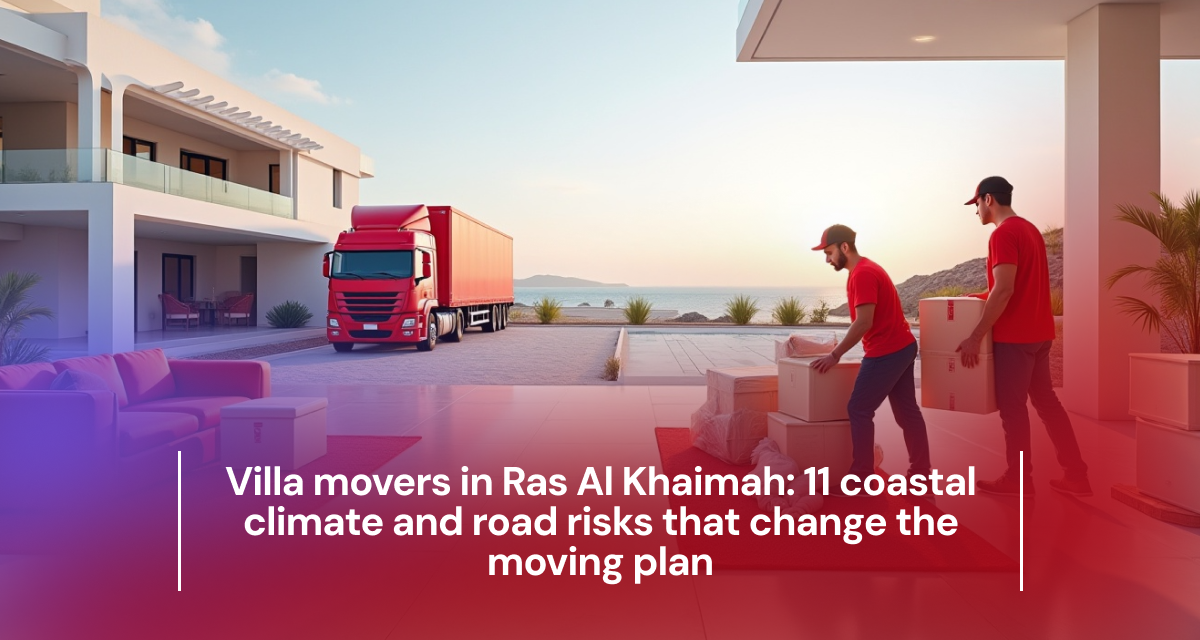
Villa movers in Ras Al Khaimah operate in one of the UAE’s most complex residential environments. Coastal humidity weakens packaging. Salt air accelerates corrosion. Heat alters adhesive performance. Roadworks and access controls disrupt schedules. These factors increase damage risk, delay exposure, and claim disputes when they are not measured and managed. Many villa relocations fail because climate and route conditions are treated as secondary details.
This article explains how 11 documented coastal and road risks affect packing, transport, and handover.
What benefits come from reading this article?
- Lower damage exposure through 11 risk controls mapped to humidity, salt air, condensation, and vibration.
- Lower delay and dispute exposure through an evidence-pack workflow tied to access, route variability, and acceptance logs.
What climate and road signals define “coastal exposure” in Ras Al Khaimah?
Coastal exposure in Ras Al Khaimah is measurable through humidity bands, temperature bands, and recurring road diversions.
- Average humidity in Ras al Khaimah: Ras al Khaimah’s humidity levels vary throughout the year. The highest levels occur in August, reaching 70% (high), while the lowest is recorded in April at 53%. Throughout the year, the average humidity in Ras al Khaimah is 63.
- Seasonality signal: There is a notable variation in precipitation between the driest and wettest months, with a difference of 27 mm (1 inch). The fluctuation of temperatures across the seasons is referred to as 14.6 °C | 26.3 °F. The month with the highest relative humidity is January, at 65.07%. The month with the lowest relative humidity is May, at 46.37%.
- Road variability signal: Local maintenance works and diversions regularly trigger congestion and timing changes on key corridors.
Risk 1: What does coastal humidity do to cartons, wraps, and upholstery?
High humidity reduces corrugated carton strength and increases moisture pickup in textiles.
A packaging study on corrugated boxes links relative humidity changes to reduced compressive resistance, with moisture affecting paper fibers and box strength.
That matters because carton compression governs stacking stability in the truck, especially when villa moves include dense loads like books, crockery, and small appliances.
Control set used by villa movers in Ras Al Khaimah
- Carton spec control: Double-wall cartons for dense payloads, with weight caps per carton class.
- Moisture barrier control: Stretch film plus sealed liner for textiles and paper-heavy cartons.
- Staging control: Short dwell time between sealing and loading to reduce ambient moisture uptake.
Field indicators
- Bulging panels on cartons.
- Soft corners and loss of squareness.
- Damp odor at the sealing stage.
Risk 2: What does salt air do to metal hardware, tools, and electronics?
Salt aerosols accelerate atmospheric corrosion rates on steel and zinc in coastal zones.
A UAE-focused corrosion mapping study reports markedly higher corrosion rates on the coast compared with inland sites, with zinc and steel rates differing by site class.
This becomes operational in villas because corrosion-sensitive items appear in every move: hinges, drawer slides, fasteners, gym equipment, outdoor furniture hardware, and home office connectors.
Control set
- Hardware segregation: Bagged and labeled hardware kits with desiccant for assemblies.
- Electronics packing: Anti-static inner protection plus sealed outer barrier for connectors.
- Exposure discipline: No open-air staging of metal parts near coastal airflow paths.
Risk 3: How does dew point create “hidden wetting” inside sealed boxes?
Condensation forms when surface temperature drops below the dew point, creating moisture inside closed packages.
Dew point represents the temperature at which water vapor condenses, and the relationship between temperature and relative humidity governs that threshold.
In coastal emirates, night cooling after a hot day creates a frequent condensation window during late loading or overnight holding.
Control set
- Time-of-day scheduling: Packing seal and truck closeout aligned to avoid late-night cooling exposure.
- Cold-to-warm transitions: No direct transfer of air-conditioned items into humid ambient without barrier packaging.
- Inspection trigger: Open-box spot checks for textiles and paper goods after any overnight hold.
Risk 4: What does heat do to adhesives, veneers, and polymer wraps?
Heat softens adhesives, increases creep, and degrades some polymer behaviors during long exposure.
In Ras al-Khaimah, the summers are long, sweltering, muggy, and arid; the winters are comfortable and dry; and it is mostly clear year-round. Over the course of the year, the temperature typically varies from 55°F to 108°F and is rarely below 49°F or above 113°F.
Control set
- Adhesive selection: High-tack tape rated for warm environments for carton closure.
- Wrap layering: Two-stage wrapping for high-value furniture, with a non-staining inner layer and a structural outer layer.
- Truck loading geometry: Zero direct sun exposure for leather and veneer faces during loading pauses.
Risk 5: How do dust and low visibility events change route and safety risk?
Fog and dust events reduce visibility and change travel speed, increasing schedule uncertainty and incident exposure.
For villa movers in Ras Al Khaimah, visibility degradation shifts the risk balance toward more travel time variance and higher stop-start cycles.
Control set
- Weather gating: Confirm advisory status before dispatch.
- Route redundancy: Primary and alternate approach routes stored in the move plan.
- Time buffer accounting: Separate buffer for weather risk, distinct from access risk.
Risk 6: What do road vibrations do to glass, joints, and fragile assemblies?
Truck vibration causes fatigue, loosening, and micro-impact that accumulates into breakage.
Research on truck vibration during transport identifies vibration as a damage driver across transported goods, with intensity and exposure duration affecting damage outcomes.
In villa moves, the highest-risk classes include mirrors, glass shelves, stone tops, joinery-heavy cabinets, and framed art.
Control set
- Cushion design: Edge protectors plus corner blocks plus void-fill matched to item mass.
- Load restraint: Straps at defined intervals with anti-slip mats for stacked items.
- Orientation rules: Glass shipped vertically with rigid frame support, not flat.
Risk 7: How do roadworks and diversions create overtime and extra trips?
Diversions increase drive time variance and can break fixed access windows at origin or destination.
Control set
- Diversion monitoring: Capture advisory sources in the move file 24 hours before execution.
- Slot protection: Arrival window set earlier than gate slot to absorb route variance.
- Trip minimization: Single-pass loading plan to avoid second runs triggered by time loss.
Risk 8: What do community gates and security checks do to productivity?
Gate procedures convert minutes into idle labor cost when approvals and IDs mismatch.
Security gates often require identification, access approvals, and defined vehicle details. That reality becomes cost-relevant because labor and vehicle idle time accumulate faster than packing time in controlled sites.
Control set
- Access packet: Building approval, unit number, contact name, vehicle plate list, and time slot.
- Crew credential discipline: ID availability, role list, and entry order planned.
- Queue strategy: Staging vehicle and crew to reduce gate congestion footprint.
Risk 9: What do parking geometry and turning constraints change in the plan?
Tight turning radius and limited bay depth change vehicle choice, crew pathing, and carry distance.
This risk appears in coastal communities with constrained internal roads and visitor parking rules. It shifts a move from “direct loading” to “relay loading,” where distance adds handling cycles.
Control set
- Vehicle matching: Truck size matched to road geometry, not only volume.
- Carry-path mapping: Measured carry distance and stair count added to the scope.
- Surface protection: Floor runner systems to protect finishes under repeated traffic.
Risk 10: What compliance and licensing details reduce execution and dispute risk?
Licensed land transport activity and vehicle equipment requirements provide a compliance baseline that supports operational credibility.
UAE land transport regulation references licensing for practicing land transport activity and technical and safety requirements for the land transport means.
The same law text also references operating cards and driver obligations tied to documents and approved routes.
Procurement checkpoint for villa movers in Ras Al Khaimah
- License verification for the transport activity.
- Vehicle compliance and safety tool readiness.
- Operating card documentation discipline, where applicable.
Risk 11: Why do claims fail without an evidence pack?
Claims fail when the proof chain breaks between the pre-move condition, custody, and handover acceptance.
Evidence failure typically comes from missing condition photos, incomplete inventory identifiers, and unclear acceptance records. Public service workflows for accident reporting illustrate how authorities request photos and documentation as evidence inputs.
What does an evidence pack contain for villa movers in Ras Al Khaimah?
- Inventory register: Item ID, room tag, material class, risk class.
- Condition photo set: Timestamped wide shot plus close-ups of existing marks.
- Seal and custody log: Truck seal ID, open-close times, handler list.
- Exception log: Damaged-on-arrival notes with photos and signatures.
- Handover acceptance: Room-by-room placement confirmation plus final sign-off.
Conclusion: What changes a Ras Al Khaimah villa move from routine to controlled?
Villa movers in Ras Al Khaimah succeed when the move plan treats coastal exposure and route friction as measurable variables, not background conditions. Humidity and dew point affect carton strength and hidden wetting. Salt air elevates corrosion risk on hardware and connectors. Heat changes adhesive behavior and wrap integrity. Road vibration increases breakage probability for glass, joinery, and stone. Roadworks, diversions, gate checks, and parking geometry are then used to decide whether a schedule holds or collapses into extra trips and overtime.
A controlled outcome comes from two disciplines. First, apply technical controls that match the risk class of each item, including barrier packing, restraint mapping, and heat-aware staging. Second, complete an evidence pack that preserves condition proof, custody proof, and handover acceptance. That combination reduces damage exposure, stabilizes timing, and improves dispute readiness when claims or exceptions occur.
FAQs
What is the biggest climate risk for villa movers in Ras Al Khaimah?
Humidity-driven moisture ingress is the most common trigger because it affects cartons, textiles, and odor control.
Why does dew point matter during packing and transport?
Dew point defines condensation risk during cooling cycles, which can wet items inside sealed cartons without visible leaks.
Which items are most sensitive to road vibration in a villa move?
Glass, mirrors, framed art, stone tops, and joinery-heavy furniture show the highest vibration-related damage exposure.
How do roadworks and diversions increase moving costs?
Diversions increase travel time variance and can break fixed access slots, creating overtime and reattempt delivery risk.
What documentation reduces gate delays in gated communities?
A complete access packet with approvals, time slot, contact, crew list, and vehicle details reduces entry failure events.
What makes a move claim fail most often?
Missing condition photos, incomplete inventory identifiers, and weak acceptance records break the proof chain needed for claims.