
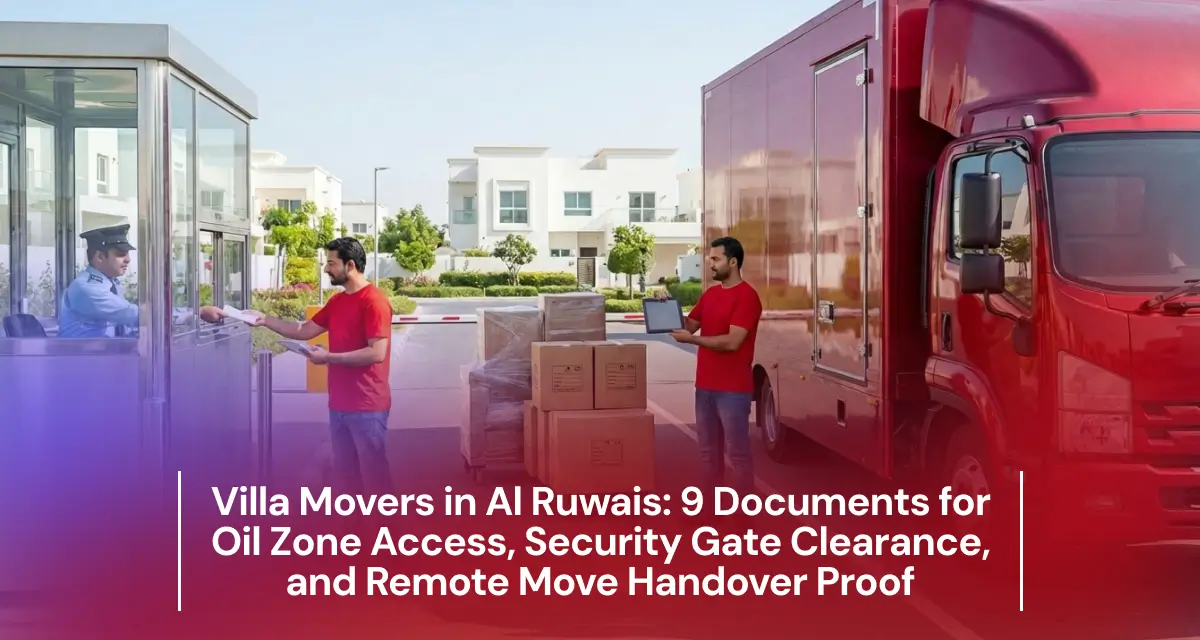
Villa moves in Al Ruwais operates under strict oil-zone access controls, where missing paperwork can stop trucks at the gate, delay entry, or create handover disputes. Standard packing and transport alone are not enough. Controlled zones require verified crew identity, vehicle clearance, delivery slot authorization, and documented proof of item condition and acceptance.
This guide explains the 9 essential documents that turn a remote villa move into a structured, approval-ready process.
What benefits does this article deliver?
This article reduces gate rejection risk by converting access requirements into a document-controlled workflow. It also reduces claims friction by turning handover proof into a traceable evidence pack with inventory reconciliation and photo logs.
The rest of this guide breaks the work into 9 documents that procurement teams, site admins, and villa residents can validate before trucks enter controlled zones.
What makes villa movers in Al Ruwais different from a standard villa move?
Villa movers in Al Ruwais operate in a controlled-access environment where identity, vehicle clearance, and timing governance drive success more than packing speed. Oil and industrial security contexts commonly use pass and onboarding workflows that require sponsor-linked access requests.
In Abu Dhabi oil and industrial contexts, access governance often includes security passes and contractor onboarding steps. Abu Dhabi National Oil Company (ADNOC), for example, publishes a Letter of Assistance path for security passes that routes requests through its external portal and contractor onboarding systems.
The operational consequence is simple. A move plan that starts with packing and trucking often fails at the gate. A move plan that starts with documentation clears constraints earlier.
What figures quantify the cost of waiting time and re-entry patterns?
Waiting time is a measurable cost driver in any gated logistics chain. The American Transportation Research Institute reported that truck driver detention created $3.6 billion in direct expenses and $11.5 billion in lost productivity in 2023. Transport industry reporting tied the same dataset to detention occurring on 39 % of deliveries in survey results.
A household move is not line-haul freight. The cost mechanism remains consistent. Gate queues consume labor hours, vehicle availability, and slot windows.
What figures quantify loss and damage risk in real-world moves?
Claims and damage occur often enough to justify evidence-first handover design. A new analysis shows that 21 % of all domestic Defense Department household goods shipments in 2018 had at least one damage claim.
New research from Direct Line Home Insurance1 reveals almost 21 million items have been lost, damaged, or stolen during home moves across the UK – with four million of these coming in the past year alone. Nearly 10.4 million people (22 %) reported their possessions did not make it to their new home in the same condition they left in, with an average repair or replacement cost of around £700.
These figures support a documentation stance: proof reduces the time-to-decision in disputes.
What data custody rule applies when access lists contain ID information?
Access lists and ID copies qualify as personal data and require governance controls. The UAE Personal Data Protection Law sets the baseline for processing, security, and purpose limitation in personal data handling.
A practical interpretation of moving operations is simple: limit access, limit retention, and preserve auditability for who accessed the file and when.
Security frameworks also treat access control and audit logs as core control families. ISO 27001 highlights access control, identity management, authentication information, and access rights as organisational controls.
NIST Special Publication 800-53 provides a catalog of security and privacy controls, including audit and accountability controls for protecting audit information.
What does “oil zone access” mean in document terms?
Oil zone access is a proof package. The package links people, vehicles, dates, scope, and a sponsoring relationship into a record that security teams can quickly validate.
Legal and risk teams also treat access lists as regulated information when they contain personal identifiers. The UAE Personal Data Protection Law sets expectations around appropriate security, storage period, and accessibility relative to the processing context.
Which 9 documents support oil zone access, security gate clearance, and remote move handover proof?
The 9 documents cover three proof layers: entry proof, movement proof, and acceptance proof.
Document set summary
- Access Request Summary Sheet
- Named Crew List and Role Matrix
- Vehicle Details and Plate Register
- Route and Remote Staging Plan
- Delivery Slot Confirmation Record
- Packing List and Carton Index
- Item Condition Photo Log
- Seal Record and Chain-of-Custody Log
- Handover Sign-Off and Exceptions Form
1) What is an Access Request Summary Sheet?
An Access Request Summary Sheet is the single-page control record that ties the move to a location, time window, and scope.
It typically contains:
- Site name and gate reference
- Move date, arrival window, and staging window
- Scope statement in measurable terms (rooms, volume bands, special items)
- Contact roles (site admin, client rep, mover supervisor)
- Version number and last update time
This sheet functions as the “index” record. In controlled zones, index clarity reduces back-and-forth at security because it eliminates ambiguous intent.
2) What is a Named Crew List with a role matrix?
A Named Crew List is an identity-matching document that links each worker to a role and a verification method.
Minimum fields:
- Full name exactly as on ID
- Role tag using consistent labels (driver, packer, rigger, supervisor)
- Company name and sponsor reference (if used)
- Contact number for supervisor only
- Validity window (start and end date)
A practical data custody rule applies here. Personal data processing requires governance, including limiting storage duration and controlling access based on processing context.
3) What is a Vehicle Details and Plate Register?
A Vehicle Details and Plate Register is the gate-clearance anchor for trucks and support vehicles.
List:
- Plate number
- Vehicle type and size class
- Driver name and driver contact
- Trailer details, if present
- Load category tag (household goods, fragile, equipment)
This register reduces gate delays caused by mismatched vehicle details. It also supports incident response because it creates traceability for what was entered and when.
4) What is a Route and Remote Staging Plan?
A Route and Remote Staging Plan is a time and risk document that converts distance and access windows into an arrival sequence.
A remote logistics plan includes:
- Route options A and B with decision trigger conditions
- Staging point and staging duration
- Call-ahead times for gate coordination
- Parking constraints and unloading order
Why this matters in figures: detention and waiting time impose measurable costs in trucking operations. Industry research on driver detention documents material productivity loss, with detention measured in triple-digit hours per year in some sectors.
Even if household moves differ from line-haul freight, the operational physics remain similar. Waiting time consumes crew hours, vehicle availability, and slot windows. A route and staging plan is the document that absorbs that uncertainty.
5) What is a Delivery Slot Confirmation Record?
A Delivery Slot Confirmation Record is the evidence that the move aligns with the time window authorized by the receiving party or site administrator.
Include:
- Slot start and slot end time
- Gate contact name or unit admin reference
- Elevator booking reference, if applicable
- Site rules summary (unloading bay, parking, escort policy)
- Confirmation timestamp and confirmation channel
This record protects timeline integrity because it separates a “planned arrival” from an “authorized arrival.” It also reduces re-entry trips, which represent the highest-cost failure pattern in remote moves.
6) What is a Packing List and Carton Index?
A Packing List and Carton Index is the inventory spine of the evidence pack.
Minimum fields:
- Carton number with consistent format (A001 to A120)
- Room label and sub-area (Master bedroom, wardrobe bay)
- Contents category tag (kitchenware, documents, fragile)
- Handling tag (fragile, upright, temperature sensitive)
- Seal ID reference if sealed
Inventory accuracy is not cosmetic. Research across inventory systems repeatedly links record inaccuracy to operational delay and cost escalation because teams lose the ability to reconcile physical reality with the data record.
For villa movers in Al Ruwais, the carton index connects gate clearance to handover proof. It also reduces disputes because missing items become reconcilable exceptions instead of arguments.
7) What is an Item Condition Photo Log?
An Item Condition Photo Log is structured photo evidence tied to item IDs and timestamps.
A useful log includes:
- Photo ID sequence
- Item ID matching the packing list
- Condition notes in objective terms (scratch length, dent location)
- Timestamp and location tag
- Signature or initials for capture responsibility
Claims processes frequently rely on documentation at delivery. Consumer-facing moving guidance highlights the practical requirement to record damage on delivery paperwork and capture photos as evidence.
The value of the photo log increases when it connects to item IDs and the handover sign-off form.
8) What is a Seal Record and Chain-of-Custody Log?
A Seal Record and Chain-of-Custody Log is the tamper-evidence and custody-transfer document for remote moves.
Use it when:
- The route includes long-haul segments
- The load contains high-value items
- Access involves multiple gates or holding areas
- Storage or overnight staging occurs
Fields that matter:
- Seal number applied at loading
- Seal inspection points (gate entry, arrival, unload start)
- Custody holder at each stage (supervisor name)
- Exception notes (seal replaced, reason code)
This document is standard in regulated logistics because it creates a simple integrity signal. It also compresses dispute timelines because it isolates where a breach risk could occur.
9) What is a Handover Sign-Off and Exceptions Form?
A Handover Sign-Off and Exceptions Form is the final proof that converts delivery into acceptance with exceptions.
Core fields:
- Delivery completion timestamp
- Inventory reconciliation summary (total cartons, delivered cartons, exception count)
- Damage exceptions list with item IDs
- Photos referenced by ID
- Signature lines for client rep and mover supervisor
Public guidance on moving claims repeatedly emphasizes written documentation at delivery as the core evidentiary step.
This form also supports procurement and vendor governance. It creates a measurable performance record per move, which enables supplier evaluation beyond anecdotes.
How do these 9 documents reduce cost escalation in remote logistics?
Cost escalation in remote moves correlates with waiting time, re-entry trips, and claims friction. The documents address those cost drivers at different layers.
A useful way to map them is by failure mode:
- Gate rejection risk: Crew list, plate register, access summary, slot confirmation
- Waiting time risk: Route and staging plan, slot record
- Missing item disputes: Packing index, reconciliation, sign-off exceptions
- Damage claims friction: Condition photo log, sign-off exceptions, chain-of-custody
Detention research in trucking quantifies that waiting time creates measurable financial and safety impacts at scale.
A controlled-zone villa move does not equal freight, but the cost mechanism aligns: idle time turns into unrecovered cost and schedule instability.
What is a minimum “remote move handover proof” evidence pack?
A minimum evidence pack is a three-part bundle: inventory proof, condition proof, and acceptance proof.
Bundle contents:
- Packing List and Carton Index
- Item Condition Photo Log
- Handover Sign-Off and Exceptions Form
Add-ons for higher risk:
- Seal and chain-of-custody log
- Slot confirmation record
- Vehicle plate register
This structure also supports “audit trail thinking.” Each artifact references the previous one using consistent IDs, which keeps the information graph linear and extractable.
How does IT and data custody apply to access lists and ID copies?
Access lists contain personal data and require governance controls. The UAE PDPL frames security, storage period, and accessibility expectations in relation to the processing context.
A practical, PDPL-aligned control set for move documentation includes:
- Role-based access to the access list file
- Encryption at rest for stored ID copies
- Time-bound retention for access documents
- Deletion log entry after retention expiry
- Version control for list updates to prevent mismatches at gates
This keeps the documentation process compliant while preserving operational speed.
What procurement questions identify remote-ready villa movers in Al Ruwais?
Remote-ready movers present a controlled documentation system, not only manpower.
Use this procurement checklist:
- Completed template set for all 9 documents
- Version control method for access lists
- Sample redacted evidence pack from a prior move
- Defined reconciliation method, cartons in vs cartons out
- Defined photo log structure with item ID mapping
- Defined chain-of-custody checkpoints
Which document reduces which risk category?
| Document | Primary risk reduced | Primary proof output |
| Access Request Summary | Gate ambiguity | Single-page scope and window record |
| Crew List and Role Matrix | Identity mismatch | Verified names and roles |
| Vehicle Plate Register | Vehicle denial | Plate matched to driver and truck |
| Route and Staging Plan | Waiting time escalation | Decision triggers and sequencing |
| Slot Confirmation Record | Missed window | Authorized arrival evidence |
| Packing List and Carton Index | Missing items disputes | Reconciliation-ready inventory |
| Photo Log | Damage disputes | Timestamped condition proof |
| Chain-of-Custody Log | Tamper and custody gaps | Seal checks and custody transfers |
| Sign-Off and Exceptions | Dispute escalation | Acceptance with exceptions |
Closing Summary: The 9-Document Pack That Stabilizes Remote Move Risk
Remote villa moves in Al Ruwais succeed when access, movement, and handover are converted into documented proof rather than verbal coordination. The 9-document pack aligns crew identity, vehicle clearance, authorized delivery windows, and inventory reconciliation into a traceable evidence chain. This structure reduces gate rejection probability, limits waiting-time exposure, and accelerates dispute resolution because each step produces verifiable records. When villa movers in Al Ruwais use access summaries, carton indexes, photo logs, and signed handover forms together, the move transitions from a high-uncertainty event into a controlled, auditable logistics operation.
FAQs
What is the first document that villa movers in Al Ruwais prepare for oil zone access?
Which document prevents the most common security gate rejection issue?
Which document directly reduces waiting-time exposure at controlled gates?
Which document most improves missing-item dispute resolution?
Which document strengthens the defensibility of damage claims?
When does a seal and chain-of-custody log become necessary in remote moves?